



Offering health benefits is one of the most meaningful ways to support your team. However, the Indiana insurance market itself is shifting in ways that make the old way things were done less reliable than it used to be.
The traditional approach of selecting a group plan and sharing the premium cost with employees is no longer the only path forward. A growing number of small employers across Indiana are exploring Health Reimbursement Arrangements (HRAs) as a more flexible, often more affordable alternative.
What is traditional group health insurance?
Traditional group health insurance is what most people think of when they discuss insurance policies. The employer selects a health plan from a carrier, and all eligible employees are covered under the same, single policy. These plans are employer-sponsored, meaning the costs are shared between the employer and the employees. This gives your workforce access to a broad range of services including preventive care, hospital visits, specialist referrals, and prescription coverage.
A traditional group health insurance plan is usually appealing to employees for the simple reason that they don’t have to take the time and energy to shop for their own plan. Instead, coverage is handled for them as a workplace benefit.
That said, it can become a little trickier on the employer side. Group coverage comes with structural requirements. Carriers typically impose minimum participation thresholds, and employers must contribute at least a set percentage of each employee’s premium.
What is an HRA?
A Health Reimbursement Arrangement, or HRA, is an employer-funded account that allows you to reimburse employees for health insurance premiums and qualifying out-of-pocket medical expenses like deductibles, copays, and procedures that aren’t fully covered by their plan.
However, it’s important to note that an HRA is not an insurance policy on its own. Think of it more as supplementary support for your employees’ individual plans. Instead of selecting one plan for the whole group, you set aside a defined monthly allowance per employee. Each employee then shops for their own individual health insurance plan and submits qualifying expenses for reimbursement from that fund.
Now, keep in mind that because it’s not an insurance policy, it doesn’t satisfy the ACA requirements. If you have a workforce of over 50 full-time employees, you will be required to offer an additional health insurance plan like a traditional group plan.
That being said, there is added flexibility in an HRA. Unlike group plans, which can fall apart if too few employees opt in, an HRA works regardless of how many employees need coverage or are already covered elsewhere. That makes HRAs one of the most accessible health benefit options for Indiana small businesses.
This structure allows each employee to find a health plan that fits their exact needs rather than agreeing to a one-size-fits-all solution. Plus, you as the employer can control your costs through a fixed contribution while still supporting your employees.
Indiana’s Changing Health Insurance Landscape
Deciding on a health plan doesn’t happen in a vacuum. Everything that’s happening in Indiana’s insurance market can have a significant impact on your decision.
When you offer traditional group coverage, you’re purchasing from carriers that participate in Indiana’s small group market—and unfortunately, that market is narrowing.
For example, IU Health Plans, once a widely used option for employers with fewer than 50 employees, was recently purchased by Anthem, which then chose not to renew those small group contracts. Employers who had built their benefits strategy around IU’s network were left scrambling when renewal season came along.
This is the problem with a vanishing network. A carrier you’re counting on can exit the small group market entirely, leaving you with limited options and employees who lose access to the providers and facilities they’ve come to rely on.
Shifts in ACA Marketplace
Indiana employees who rely on individual Marketplace plans are also navigating uncertainty. Cigna and CareSource plan to leave the ACA Marketplace in 2027—a result of expiring federal subsidy enhancements, different provisions of H.R.1, and Marketplace rule changes. These and many other shifts are leading to premium increases and reduced enrollment across the state.
HRAs can serve as a stabilizing tool here. Because HRA funds can be used to pay premiums on individual plans as well as qualifying out-of-pocket costs, they give employees more flexibility to absorb changes in the Marketplace.
New Indiana Tax Credits for HRAs
In 2023, Indiana became the first state in the country to offer a dedicated tax credit for small business employers that replace traditional group health insurance with an HRA.
With House Bill 1004, qualifying businesses with fewer than 50 full-time employees can claim up to $400 per covered employee in the first year they adopt an HRA and up to $200 per covered employee in the second year. For a business with 49 employees, that’s up to $19,600 back in year one alone. The credit is applied against the employer’s Indiana state tax liability, and any unused credit can be carried forward for up to ten years.
Group Coverage vs. HRAs for Small Businesses in Indiana
There’s no universal right answer for whether a traditional group plan or an HRA is best. It all comes down to understanding the differences between the two and what the options mean for your business.
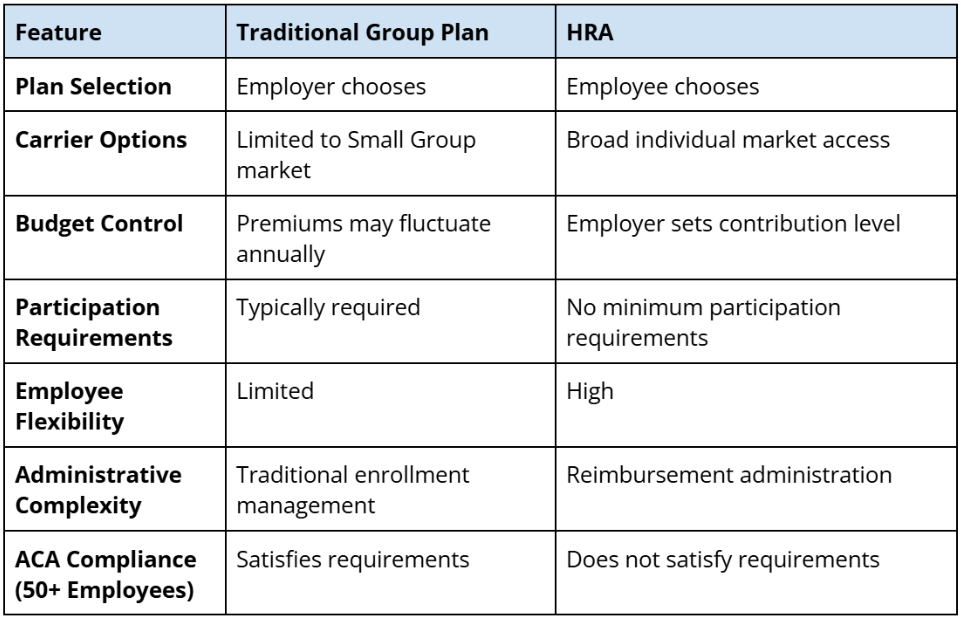
That being said, in our experience as a small business benefits consultant, we’ve seen some patterns emerge.
Group coverage may be a better fit if…
- Your business has 50 or more full-time employees and needs to comply with ACA regulations.
- Your workforce is relatively uniform as far as demographics go, making a single plan a practical choice.
- You value simplicity and want one vendor and point of contact.
- Most of your eligible employees want coverage and will participate, allowing you to meet carrier minimum thresholds.
An HRA may be the better fit if…
- Your business has fewer than 50 full-time employees and you don’t need to comply with ACA regulations.
- Your workforce is diverse, including a range of full-time, part-time, seasonal, or contractor workers with different coverage situations.
- Some employees already have coverage through a spouse, a parent’s plan, or another source, and you don’t want to pay for coverage they won’t use.
- You need cost predictability and want to set a fixed monthly benefit rather than absorbing unpredictable premium increases at renewal.
- You’ve run into minimum participation issues with group carriers, or your group is simply too small to access competitive small group rates.
Choosing between traditional group health insurance and an HRA should be focused on finding a solution that aligns with your workforce, budget, and long-term business goals.
For some Indiana employers, a traditional group plan will continue to make sense, particularly when workforce participation is high and a single plan meets the needs of most employees. For others, HRAs offer a level of flexibility, cost control, and employee choice that simply wasn't available a decade ago.
As Indiana's health insurance landscape continues to evolve, with changing carrier participation, shifting Marketplace options, and new state incentives for HRA adoption, it's more important than ever to evaluate all of your options rather than automatically renewing the same coverage year after year.
You don't have to navigate these decisions alone. At Paradigm Consulting, we help Indiana small businesses compare group health plans, HRAs, and other benefits strategies to determine the best fit for their unique needs. If you're preparing for renewal or simply want to explore whether a different approach could save money while better supporting your employees, our team is here to help.

Please let us know if you have any questions. We understand that local companies have unique needs that most national firms don’t consider or struggle to identify. This leaves your people with a less effective, one-size-fits-all benefits plan. However, our ability to cater to the needs of our clients comes from decades of client partnerships. This perspective allows us to fully address unique needs and generate creative benefits plans.
You shouldn’t have to worry about just being a number, offering a generic plan, or getting the unique support you need. Call us today.
This Benefits Insights is not intended to be exhaustive nor should any discussion or opinions be construed as professional advice.