



For most Indiana employers, health plan renewal lands on January 1. While that may seem like the simplest routine, renewing on the date quietly puts employers at a disadvantage before the process even begins.
Understanding the difference between a 12-month renewal and an off-cycle extended rate guarantee can change the way you approach benefits planning and how much you pay in the long run.
The Challenges in Renewing on January 1
January 1 is by far the most common health plan renewal date in the small group market—and that concentration is exactly what makes it problematic. When the majority of the market is renewing at the same time, the process becomes reactive rather than strategic. Employers end up facing challenges such as:
- Underwriting queues grow longer as carriers process a high volume of applications simultaneously
- Decision timelines compress, leaving limited time for analysis
- Leverage diminishes when every employer is shopping at the same time
- Employee communication gets squeezed, with little time to explain plan changes before they take effect
These are structural disadvantages built into the January renewal cycle. Indiana employers who recognize this dynamic and plan around it are better positioned to secure favorable terms and make more informed decisions.
The Benefits of Renewing Off-Cycle
Renewing outside of the January rush immediately relieves most of these pressures. Mid-year renewals give employers more time to compare carriers, evaluate plan designs, and communicate changes to employees without the urgency that defines the Q4 benefits season.
Mid-year is also when extended rate guarantees are most likely to surface. Carriers benefit from bringing new groups on outside of the January peak since underwriting workloads are more manageable and the competitive environment is less congested. Offering an extended rate guarantee is how carriers make off-cycle plan switches more attractive to employers. It rewards timing flexibility with added rate stability.
Rate Guarantees vs. Traditional Renewals
With this in mind, there are a number of key differences between a traditional 12-month renewal and an extended rate guarantee for you to consider:
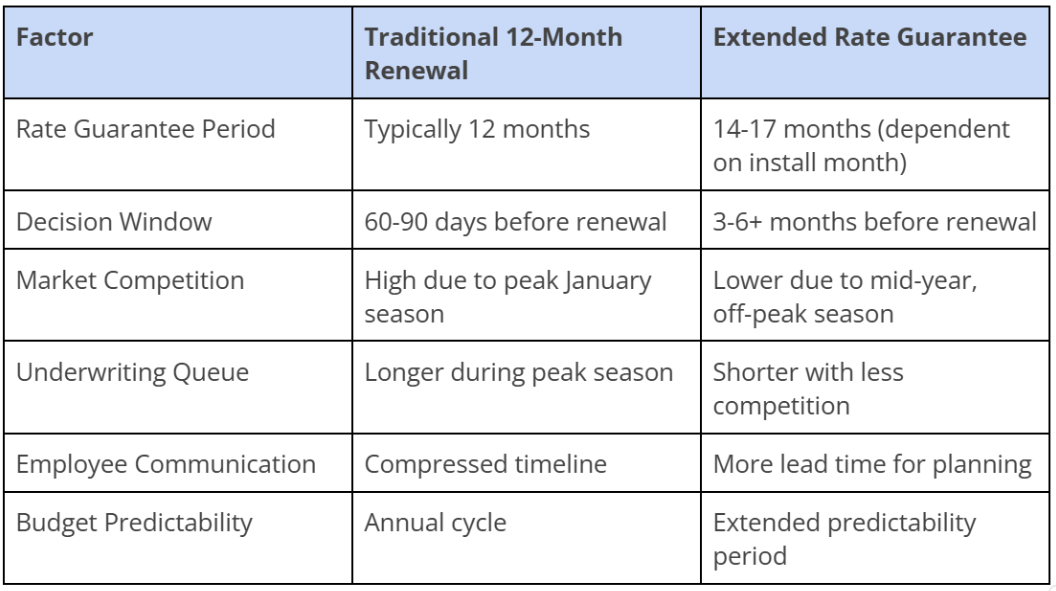
Cost Stability vs. Short Time Focus
One of the most important strategic questions in benefits planning is whether to optimize for the lowest possible rate right now or for predictability over a longer horizon. Traditional renewals tend to reward short-term thinking. You negotiate, you get a rate, and you do it again in 12 months. That cycle can work, but it also means absorbing renewal volatility annually and spending time and resources on the process every single year.
An extended rate guarantee shifts those calculations. By locking in rates for a longer period, employers gain:
- Clearer budgeting for HR and finance teams, with fewer mid-cycle surprises
- Reduced administrative burden—fewer renewal cycles over the same period
- More stability for employees, who experience fewer plan disruptions
- Greater leverage in negotiations when the market is less saturated
The tradeoff is that you are committing to a carrier and plan design for a longer time period. If market rates drop significantly or your workforce needs shift, that extended commitment can limit your flexibility. For most stable Indiana employer groups, however, the benefits of predictability outweigh the risks of being locked in, especially when the rate guarantee was negotiated during a less competitive, off-peak window.
Which works best for Indiana Employers?
As with most employee benefits, there isn’t a one-size-fits-all solution. It comes down to what is right for your specific business needs.
Employers who prioritize budget certainty, want to reduce the annual renewal burden, and are open to mid-year plan changes will generally find extended rate guarantees to be a compelling option. The longer decision window, lighter competition, and extended predictability period all work in their favor.
Meanwhile, employers who prefer maximum flexibility, anticipate significant workforce changes, or have strong existing carrier relationships may find that a well-timed traditional renewal still serves them effectively.
What matters most is making a deliberate choice rather than defaulting on January 1 simply because that’s what you’ve always done. Indiana’s small group market rewards employers who plan ahead, and the extended rate guarantee is one of the more underutilized tools available to those willing to think outside the standard renewal cycle.
Want the full breakdown of how extended rate guarantees work and how your business can get started? Download our guide “Indiana Employer’s Rate Guarantee Playbook”.
Please let us know if you have any questions. We understand that local companies have unique needs that most national firms don’t consider or struggle to identify. This leaves your people with a less effective, one-size-fits-all benefits plan. However, our ability to cater to the needs of our clients comes from decades of client partnerships. This perspective allows us to fully address unique needs and generate creative benefits plans.
You shouldn’t have to worry about just being a number, offering a generic plan, or getting the unique support you need. Call us today.
This Benefits Insights is not intended to be exhaustive nor should any discussion or opinions be construed as professional advice.